劉馬利 Reviews Taipei Chamber Singers’ “Confluence”
When the Autumn Floods Come, Ten Thousand Streams Return: “Confluence”
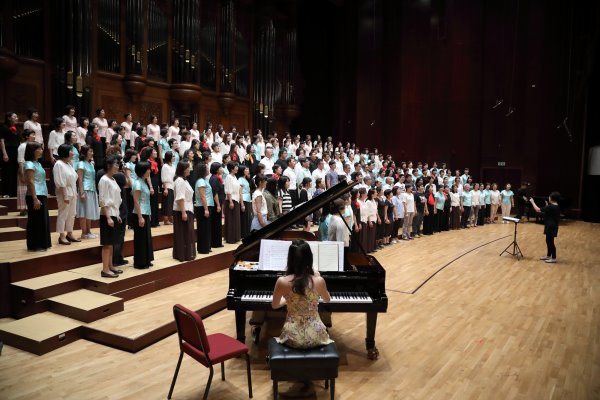
When the Autumn Floods Come, Ten Thousand Streams Return: “Confluence”
By 劉馬利 (commissioned critic)
Having traveled a quarter of a century, somewhere between the coming of age and the maturity of thirty, Taipei Chamber Singers has held fast to the time-honored rules of classical tradition, ranged freely in innovation, and stood at the very forefront of the contemporary tide. This concert was the harvest of those years. Alongside the main choir, the program featured the three TCS Women’s Choirs and the TCS Fifty Choir: the many tributaries of the TCS family, one might say, returned to the main stream, uniting to write a legendary page in song.
Compared with the 20th-anniversary concert “The Original” (原色), this program was more approachable. The first half was divided into two parts, “Celebration and the New” and “The Ultimate in Voice,” demonstrating the choir’s professional commitment to choral art; both its vocal technique and its musical tension were mature and well rounded.
Even more remarkable is that many members of the choir are established choral conductors and singers in their own right, yet they have chosen to devote themselves to this ensemble and have worked tirelessly together for years. The stability of the membership is, of course, also key to its success: many of those on stage are veteran members of long standing who, through years of building refined choral art together, have developed solid musicianship and a deep rapport.
The four works in “The Ultimate in Voice” were all premieres or commissions from the Music Unlimited series, which has become Taipei Chamber Singers’ hallmark. Grounded in Western compositional techniques and drawing on Eastern elements, these works tell old material in a new language and explore a single theme in complex ways: aleatoric passages roam over pentatonic scales, and time notation interweaves with spatial notation. Over the years the choir has interpreted a great many new works by contemporary composers, continually developing new repertoire, with more than a hundred commissioned works to date. Yun-Hung Chen, a conductor who is rigorous in everything, with solid conducting technique and total dedication, has continually led the singers to “break out of the cocoon,” forging an experimental and distinctive vocal aesthetic.
Perhaps because these contemporary works are so demanding, or because there seemed to be some changes in the lineup on stage, the musical tension in certain places could have been developed further. The rhythmic drive and drama of “Tsang Tse” (鑼鼓運動), for example, could have been heightened. Listeners on the second level may have been able to sense the playfulness of “filling out the rhyme with sound” and the irregular rhythms, but from my seat on the 4th floor (Row 2D, Seat 2) the musical tension felt out of reach, and for listeners hearing this kind of work for the first time it may be a challenge.
The second half brought the whole TCS family together, like ten thousand streams returning home, as a response to the public’s support and affection over the years. It was divided into three parts: “Warm Women’s Voices,” “Taiwan Through the Years,” and “Legacy.” First on stage was TCS Women’s Choir led by 方素貞, singing four classic popular songs spanning nearly a century. This “women’s brigade” of amateur enthusiasts, devoted to making friends through music and promoting choral art, displayed tremendous team spirit. Apart from a little stage fright in the first song, “A Little Happiness” (小幸運), the lively body language of the next, “Grandma’s Penghu Bay” (外婆的澎湖灣), revealed their passion for music through the familiar melody and swept away the earlier nerves. “My Child” (我的囝仔) and “Dancing Era” (跳舞時代) built on that momentum, striking a warm chord with the audience and conveying a heartfelt sense of happiness.
The four songs of “Taiwan Through the Years” that followed were sung by the main choir together with the Women’s Choir and the Fifty Choir. All were arrangements of folk songs, pop songs, and campus folk songs in a variety of styles, leading us across the long river of time to look back on golden years gone by. In the next section, “Legacy,” the atmosphere grew warmer and more profound still. Judging from the second-half program, it is gratifying to see so many talented arrangers emerging in Taiwan, enriching the choral stage with popular music and allowing more people to share these remembered songs through singing.
That said, some arrangements may need further consideration. Many of these are household-name pop songs, and audiences already hold firm impressions of them. A song is sometimes popular because people love the original singer’s voice, so not every pop song is suited to choral arrangement, unless it is given a carefully constructed musical architecture that fills the new arrangement with substance. Arranging thus involves many considerations: making much of a small subject while avoiding vulgarity, and developing the material continuously without merely gilding the lily. It is a test of the arranger’s technique and personal taste.
This performance shows how Taiwan’s choral standards have continued to rise over the past twenty-five years, and the efforts of Yun-Hung Chen and the TCS family have played no small part. In this season of early autumn, on the stage of the National Concert Hall, they carried forward the beauty of choral singing with the most persuasive of voices. Whether metaphysical, popular, scholarly, or nostalgic in style, through everyone’s efforts, as a hundred streams pour into the river and swell its flow, the current has long since gathered into an unstoppable force.