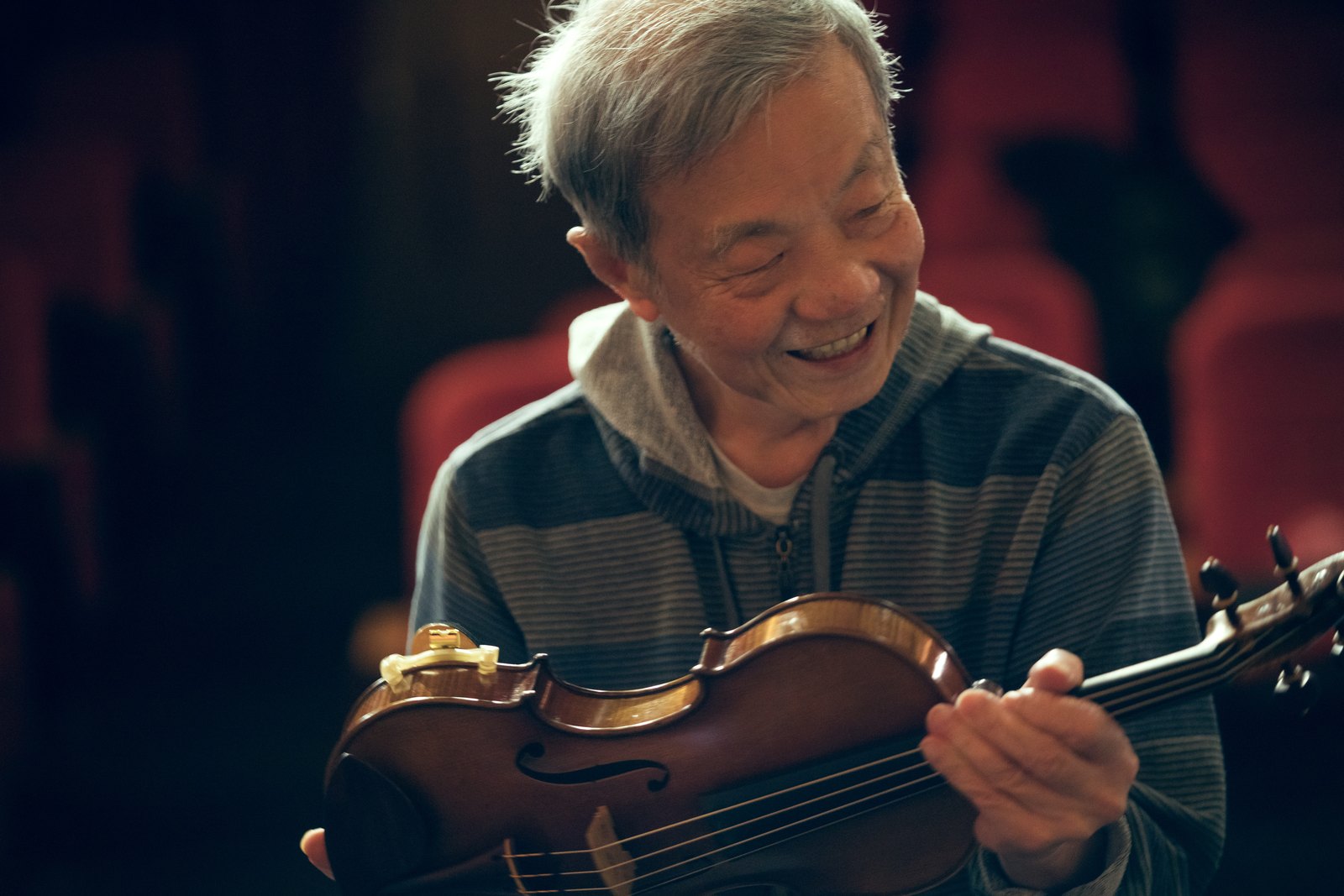
David L. Wen David L. Wen
David L. Wen was born in Taipei on 7 March 1944. He began studying violin and piano at the age of seven and wrote his first piece at thirteen. After high school he entered the string program of the music department of the National Taiwan Academy of Arts, double-majoring in violin and composition; he studied composition with 陳懋良 and was mentored by Hsu Tsang-Houei. After graduating, Wen joined the Taiwan Provincial Symphony Orchestra (today’s National Taiwan Symphony Orchestra) as a first violinist, while also a member of the Sunflower Music Society (向日葵樂會) and presenting works with the Making Music Ensemble (製樂小集).
In 1970 Wen won first prize at the 2nd Huang Tzu Composition Competition with the choral work “Ode to the Prince of Yanping” (延平郡王頌), and the following year won first prize at the 1st Chinese Contemporary Music Composition Competition with the timpani quintet “Phenomena I” (現象I). In early 1972 his sonata for violin and piano “The Twelve Zodiac Animals” (十二生肖) was selected for the International Gaudeamus Composers Competition in the Netherlands. In 1975 both his large chamber work “Work 1982” (作品1982) and “Phenomena II” (現象II) for flute, cello, piano and percussion were selected for the Gaudeamus competition, with Phenomena II winning second prize—making him the first Asian composer to win a prize at this international competition. After returning to Taiwan in 1975 having brought honor to the country, Wen was named one of that year’s Ten Outstanding Young Persons; he received the 21st Chinese Literature and Art Medal in 1980 and the 3rd Wu San-Lien Award for Literature and Arts in 1982. The recipient of numerous awards, he set out to serve the public with his musical expertise.
Wen’s works are both numerous and finely crafted, and he is one of the few composers in the world able to make a living from commissions and royalties. Chamber music is his most prolific area, with representative works such as the “Phenomena” series and the large chamber work “Work 1974” (作品1974). Wen has also worked tirelessly for percussion education, advocating for percussion courses at the Ministry of Education and writing many percussion works, such as “To the World” (給世人) for percussion ensemble and female voices; the theatre piece for solo percussion “Tracing Back to the East” (溯及東方); and “Two Essays” (隨筆二章) for solo glockenspiel.
In 1992 he emigrated to the United States, and in 1997 was invited to New York University as composer-in-residence and teacher of composition. After retiring, he founded the CLAP&TAP Chamber Orchestra (柝之響), presenting concerts and summer camps and touring in Taiwan and abroad, and established branches of the orchestra in both Taiwan and Malaysia. Bringing together education, performance and community, Wen continues to lead the orchestra to new heights.
Since founding the Formosa String Quartet in 1964, he has not only performed and composed but also taught chamber ensemble technique. String quartet music has been something he listens to every day. Over sixty years he has completed six major string quartets, Nos. 1 to 6. The energy and inspiration gathered in these works are closely tied to his love of chamber music and his accumulated experience. As of 2022 he has also completed ten symphonies, an achievement that likewise owes a great deal to the experience gained through string quartet writing.